Wednesday, 29 February 2012

March 2. Arthur's Seat

So the plan for Friday is to have a visit to Arthur's Seat. I would like to pay more than one visit to Arthur's Seat, if you are willing, because it is a rewarding and varied area to photograph.
Conditions -according to the weather charts,  the high pressure sitting over our Scandinavian friends' western seaboard is sort of holding back the low pressure and the weather fronts - the wavy red or blue lines sitting west of Britain. There is a warm weather front in the north sea. So what this means for us is the weather should be fairly settled, maybe a bit breezy, good visibility but probably some cloud cover. The light then, will be diffused because of the clouds, and soft. Quite different from last Friday, when it was very contrasty, or hard. The soft light is likely to give rise to quite muted, gentle colour and in fact may lend itself to black-and-white photography.


The idea - to avoid simply going for a random wander with a camera we should try to have an idea for what to look for and to explore visually. It is very striking to have a mountain - a volcano! - in the middle of a civilised city. It is a stark contrast, and photographers do enjoy just such a contrast - a juxtaposition they sometimes call it; or an edge line. So let's try to explore the edge line between the civilised city, and the wild volcano. (Let's not fall over the edge.)


Salisbury Crags and Edinburgh from Arthur's Seat. Picture by me.
I would also like to concentrate on some shooting technique. Shooting should consist of three distinct decisions - focus, expose, frame. That is: 1 - decide exactly what to focus on, then lock the focus, 2 - decide exactly what to take a light reading/exposure from and lock the exposure, 3 - frame and compose the picture. Each of these decisions can have a huge impact on the resulting image. So if you don't know how to use your camera to lock the exposure, and lock the focus, try to have a look at the manual. Failing that we can try to work it out on Friday...
The route we'll take is quickly through town and Dumbiedykes, then up on to the Radical Road and on to the top of the Crags. If there's time we can extend this and go on to the top. Plenty of places to explore.
David Springford sells prints of photographs of Edinburgh, including Arthur's Seat, and this one shows lovely awareness of tone and light, as well as movement.
He has clearly given careful thought to the point that he focusses the lens at - notice how parts of the image are pleasantly soft, while the mountain is sharp; and he is leading the viewer's eye on a pleasant journey through the varieties of light, tone and texture. Working in black-and-white does encourage you to think out about the real fundamentals of tone, design, texture and so on.
Picture by David Springford - http://www.infinityphotos.co.uk/


Friday, 24 February 2012

February 24

Welcome to the Stills Environmental photography course.


What we will be doing on the course depends very much on what you want to get out of it - so do let me know. (I have a few ideas of my own, of course.)
I have found that most people like to spend as much time actually out and about, shooting. I use this blog to introduce ideas and show some styles of photography that will be helpful when we are out shooting; and I also use it to keep you informed of meeting arrangements and locations.
I can also be contacted at kbrame@blueyonder.co.uk
My background is in professional editorial and corporate photography, and I have produced landscape photography of some of the wilder parts of Scotland for the land conservation charity, the John Muir Trust.
You can find a examples of that project at:
http://pa.photoshelter.com/c/brame 
www.keith-brame.com 


and http://kbrame.blogspot.com - I try to update this blog and I plan to develop it as a photographic education site, so it might be worth keeping an eye on...


The basic preparation for any day out shooting is this:

  • The location
  • The conditions
  • The idea
  • The inspiration
  • The route
Simple enough, and these can vary in detail and complexity, and we will explore them more fully during the next few weeks.


So today:
Source : met office
  • The location is Stills and the Old Town
  • The conditions will be bright, cool, clear, contrasty, low-angled light. Wonderful late winter northerly latitude conditions after a cold front has passed through. This information came from the met office pressure charts
  • The idea may be a simple visual one or something with a bit more conceptual content. The visual idea may flow from the conditions - so today we could explore the visual idea of high contrast light, and explore the extremes of brightness and shade. The idea may also be a larger unifying project idea that links your shooting together to create a coherent project theme.
  • The inspiration - there's a lot of good photography out there to help us. Sometimes this can make us feel that it has all been done before. Paul Hill has remarked in his book, 'Approaching Photography', that "you haven't done it, and it is important to remember that fact."  Jerome Loreau has an eye for light and contrast in his travel photographs that include Edinburgh.


http://jeromelorieauphotography.com/

http://jeromelorieauphotography.com
Going a bit further back, the American photographer Alvin Langdon Coburn paid photographic visits to Edinburgh, inspired by the stories of Robert Louis Stevenson.

'Weir's Close', Alvin Langdon Coburn


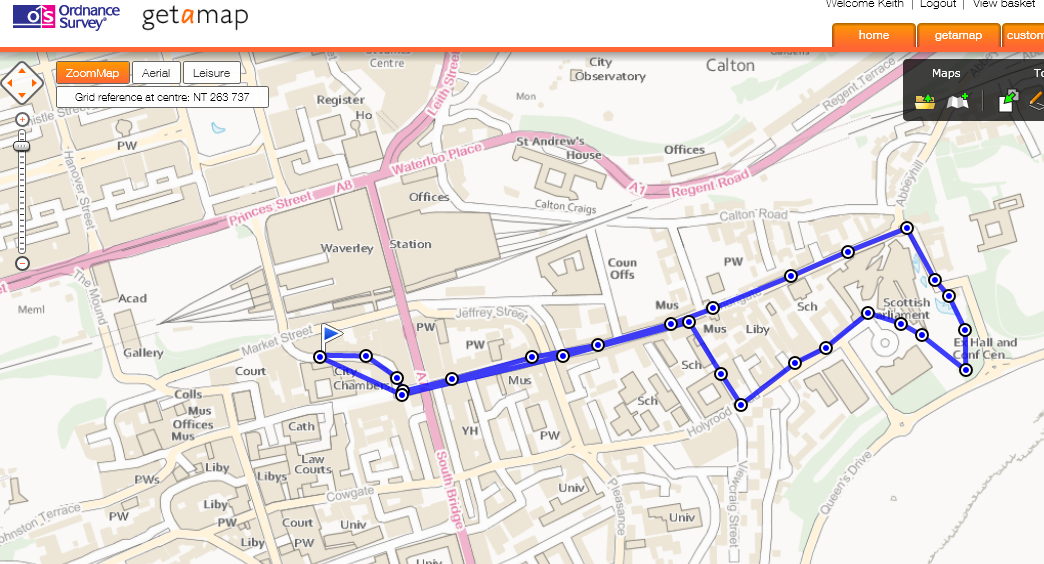
  • The route - today I suggest heading down the Royal Mile and Cannongait to the Parliament, then round the back of the Parliament past Dynamic Earth and up one of the wynds and back up the High Street. Along the way the light may be zinging through the wynds, reflecting off windows and buildings...then again, it might not.
The OS Getamap service is excellent for creating routes, saving, sharing and printing them. For routes in the country, I use the OS maps with contours, as this helps to previsualise the terrain. It is worth learning map reading for the sake of safety if nothing else.

http://www.getamap.ordnancesurveyleisure.co.uk


Thursday, 9 June 2011

Ara Guler

Ara Guler is a wonderful photographer of Istanbul. This has nothing at all to do with this course, but just great photography from someone who loves his city, and has the ability to show it. His own website has a very fine music soundtrack (Take Five) and slide show. I recommend that you make a coffee (espresso, or Turkish) and let it play. Call it research.


http://www.lensculture.com/guler.html?thisPic=100
http://www.araguler.com.tr/


Wednesday, 8 June 2011

Colour in landscape

Marion sent me a link to some of her pictures from last week's Newhaven visit. The bleach colour style is effective, giving a means of interpreting the scene a little, rather than just recording what you see. It does remind me of a cross processing technique that we used to employ with film. If you process colour slide film in colour negative chemistry you can end up with punchy vibrant colours. If you you process negatives in slide chemistry, you get bleached, slightly cyan colour, giving a bit of a queasy, dystopian feel. This is an example of how you might use a technique to match your mood or point of view.
The titles of the pictures here suggest a slightly ironic point of view, and the drained and slightly off-colour matches this.
There is a temptation, if you shoot colour, to go for as much saturation and intensity as possible. This s a habit that John Fowles in his intro to Fay Godwin's 'Land' described as "making the landscape perform." For a long time colour was not considered a suitable medium for serious photography.
It was photographers like Paul Graham who changed that perception with subtle, understated and often symbolic use of low saturated colour in projects like 'Troubled Land' and 'A1-Great North Road.' 
Another very interesting colour photographer of disturbing landscapes is Simon Norfolk, whose 'Bosnia-Bleed' series is very topical still, and perhaps always should be, but is not especially easy viewing. Richard Misrach works in a similar vein, and it should be noted that many of these pictures are produced with large cameras and reproduced as large prints in books and gallery walls. The incredible descriptive power and detail produced can make even low saturated pictures of relatively mundane subjects seem quite hypnotic; and the context provided by titles and captions can jolt and disturb you.


Friday June 10 - Red Moss of Balerno, Threipmuir

So I went to the abandoned shopping centre for a look about and to see if we could get access for Friday. I wandered through the security gate, past the CCTV cameras and loudhailers looking for someone to ask. It was an interesting, slightly eerie place, and I took a few record pictures while looking for the security guard. He eventually found me, and promptly threw me out. Next time I will go through the proper channels, instead of a gap in the gate. Let's go to Threipmuir instead, it's less weird. It's just outside Balerno, on the edge of Edinburgh city, and you can move from a raised bog, the 'Red Moss'  full of bog-cotton, through beech tree avenues and onto the moors of the Pentland hills. I went for a look around this evening, and got stuck in the bog (not literally), exploring the cotton, the sphagnum mosses, birch wood and ferns. A good place to photograph, and it might be useful to bring macro kit if you have it, and wellies if you want to tiptoe off the walkway.
Here are the Google map directions.
If you go to Balerno and follow the signs to Threipmuir reservoir, park in the first carpark right next to the Red Moss.

Wednesday, 1 June 2011